
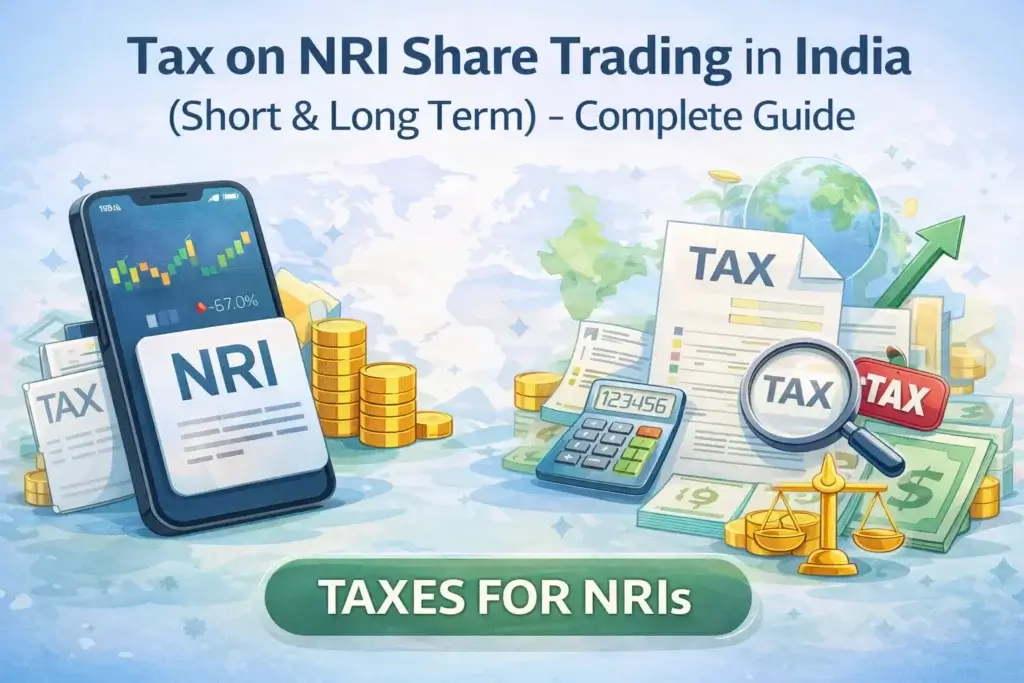
Tax on NRI share trading explained with examples. Learn short-term & long-term capital gains tax for NRIs, TDS rules, exemptions, and filing tips.
If you’re an NRI investing in Indian shares, let me ask you something honestly.
Have you ever looked at your contract note and wondered, “Wait… why was tax already deducted?”
Or maybe you sold a stock at a profit and later worried, “Do I need to pay tax again in India?”
If yes, you’re not alone.
The tax on NRI share trading is one of the most confusing parts of investing from abroad. Add RBI rules, PIS reporting, and compulsory TDS, and suddenly things feel overwhelming.
So in this guide, I’ll explain tax on NRI share trading in the simplest way possible. We’ll also break down capital gains tax for NRIs using real-life examples, short sentences, and smooth transitions.
Let’s get started.
Table of Contents
- Why Tax Planning Is Crucial for NRIs
- Basics of Tax on NRI Share Trading
- Capital Gains Tax for NRIs – The Foundation
- Short-Term Capital Gains Tax for NRIs
- Long-Term Capital Gains Tax for NRIs
- Equity vs Non-Equity Tax Rules
- How TDS Works on NRI Share Trading
- Double Taxation & DTAA Relief
- Tax on Intraday & F&O Trading for NRIs
- Tax Filing Rules for NRIs
- Real-Life NRI Examples
- Common Mistakes NRIs Make
- FAQs – Tax on NRI Share Trading
- Final Thoughts
Why Tax Planning Is Crucial for NRIs
As an NRI, you already manage:
- Foreign income
- Indian investments
- Multiple tax laws
That’s exactly why tax on NRI share trading needs special attention.
Unlike resident Indians, NRIs face automatic TDS, even before profits reach their bank account. Therefore, understanding capital gains tax for NRIs isn’t optional — it’s essential.
Good tax planning helps you:
Avoid future penalties
Reduce excess tax deduction
Improve cash flow
Basics of Tax on NRI Share Trading
Let’s start with the fundamentals.
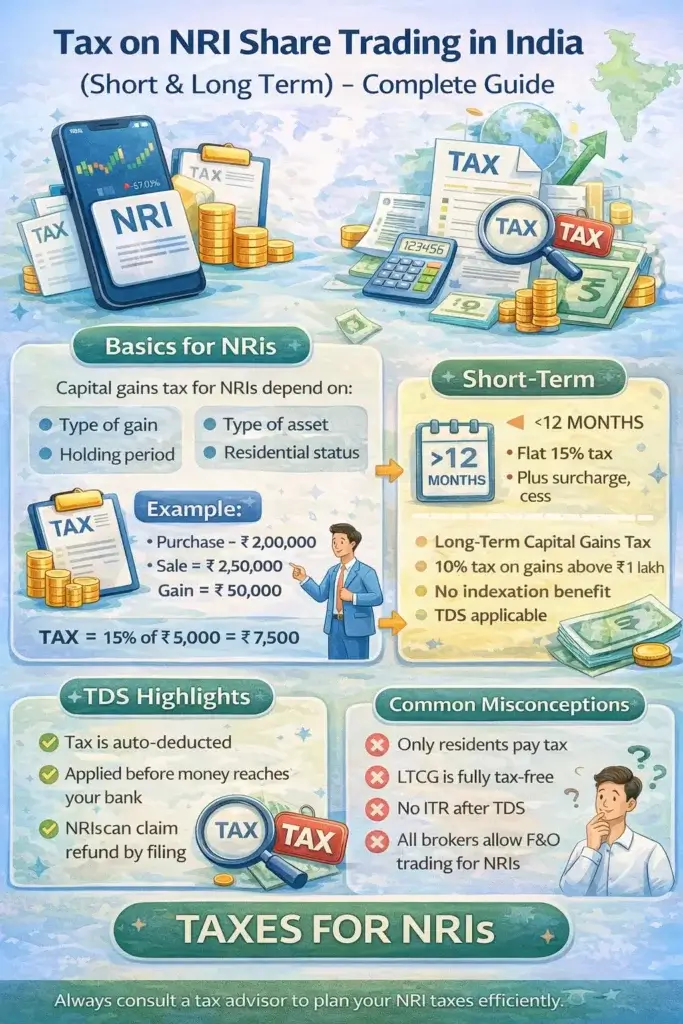
When an NRI trades in Indian shares, tax depends on:
- Type of gain (short-term or long-term)
- Type of asset (equity or non-equity)
- Holding period
- Residential status
So whenever we discuss tax on NRI share trading, we are essentially talking about capital gains tax for NRIs.
Capital Gains Tax for NRIs – The Foundation
At its core, capital gains tax for NRIs is tax on profit made when you sell an asset.
There are two main categories:
- Short-Term Capital Gains (STCG)
- Long-Term Capital Gains (LTCG)
Understanding this distinction is the first step toward mastering tax on NRI share trading.
Short-Term Capital Gains Tax for NRIs
What Is Short-Term Capital Gain?
If you sell equity shares within 12 months, the profit is treated as short-term capital gain.
Tax Rate on STCG for NRIs
Flat 15% tax
Plus surcharge and cess
TDS deducted at source
Example
Purchase value: ₹2,00,000
Sale value: ₹2,50,000
Gain: ₹50,000
Tax on NRI share trading:
15% of ₹50,000 = ₹7,500 (+ cess)
Long-Term Capital Gains Tax for NRIs
What Is Long-Term Capital Gain?
If equity shares are held for more than 12 months, the gains become long-term.
Tax Rate on LTCG for NRIs
10% on gains above ₹1 lakh
No indexation benefit
TDS applicable
Example
- Total gain: ₹1,80,000
- Exempt: ₹1,00,000
- Taxable: ₹80,000
- Tax: ₹8,000
This is a key component of tax on NRI share trading strategy.
Equity vs Non-Equity Tax Rules
Equity Shares (Listed)
STCG: 15%
LTCG: 10% above ₹1 lakh
Non-Equity / Debt Instruments
- STCG: As per slab rate
- LTCG: 20% with indexation
So when planning capital gains tax for NRIs, asset choice matters a lot.
How TDS Works on NRI Share Trading
This is where most NRIs feel the pinch.
For NRIs:
- Tax is deducted at source
- Deducted before profits are credited
In short, tax on NRI share trading is prepaid via TDS.
👉 Even if your final tax liability is lower, TDS still applies.
👉 Refunds can be claimed by filing an ITR.
Double Taxation & DTAA Relief
Here’s some relief.
India has DTAA agreements with many countries. This ensures:
- No double taxation
- Foreign tax credit availability
So while capital gains tax for NRIs applies in India, DTAA helps avoid double burden.
Tax on Intraday & F&O Trading for NRIs
Where permitted:
- Treated as business income
- Taxed as per slab rates
- Advance tax may apply
Clearly, tax on NRI share trading differs greatly for traders versus investors.
Tax Filing Rules for NRIs
NRIs should file returns to:
- Claim TDS refunds
- Report capital gains
- Remain compliant
This completes the capital gains tax for NRIs cycle.
Real-Life NRI Examples
Gulf-Based NRI
Long-term investor
Pays only LTCG
Claims refund via DTAA
US-Based NRI
Short-term trader
Higher TDS impact
Needs careful planning
Common Mistakes NRIs Make
- Ignoring TDS impact
- Not filing ITR
- Misunderstanding holding period
- Assuming gains are tax-free
Avoid these to manage capital gains tax for NRIs better.
FAQs – Tax on NRI Share Trading
Is tax mandatory for NRIs?
Yes. Tax on NRI share trading is compulsory.
Do NRIs pay LTCG tax?
Yes. Capital gains tax for NRIs applies above ₹1 lakh.
Can NRIs get tax refunds?
Yes, by filing an ITR.
Final Thoughts
Tax may not be exciting. However, clarity brings confidence.
Once you truly understand tax on NRI share trading, investing in India feels simpler. And when you plan capital gains tax for NRIs smartly, you keep more of what you earn.
Learn the rules. Plan early. Invest confidently.
⚠️ Disclaimer
This article is for educational purposes only. Please consult a qualified tax professional or SEBI-registered advisor before making investment decisions.

Pingback: Mutual Funds for NRIs: Rules, Tax & Best Options 2026