

Union Budget 2026 explained for NRIs. Key announcements, policy updates, tax changes, and market impact on stocks, mutual funds, and investments.
Union Budget 2026: Key Announcements, Policy Updates & Market Impact for NRIs
Table of Contents
- Why This Budget Matters for NRIs
- The Bigger Picture Behind the Budget
- Core Priorities and Policy Direction
- Major Government Announcements Explained
- Tax Updates Investors Should Understand
- What NRIs Should Pay Attention To
- Sector-Wise Market Impact Analysis
- Impact on Stock Markets
- Impact on Mutual Funds and SIPs
- Effect on Gold, Bonds, and Currency
- Smart Moves for NRIs After the Budget
- Common Investor Mistakes to Avoid
- Long-Term Signals for India’s Economy
- FAQs
- Final Thoughts
Why This Budget Matters for NRIs
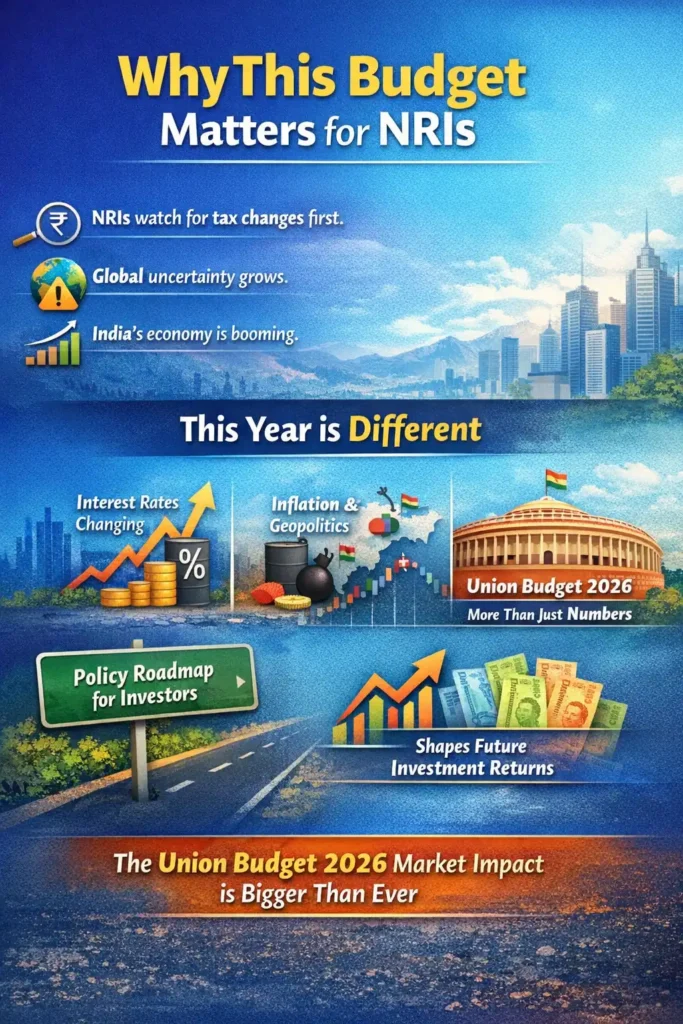
Every year, Indian expatriates closely watch the Union Budget.
Naturally, most people look for tax changes first.
However, the bigger picture often gets ignored.
This year is different.
India is growing fast, yet global conditions remain uncertain.
Interest rates are changing worldwide.
Meanwhile, inflation and geopolitics still matter.
Because of this backdrop, the Union Budget 2026 becomes more than a routine financial statement.
Instead, it works as a policy roadmap for investors.
More importantly, the market impact of Union Budget 2026 shapes investment returns over the next few years.
The Bigger Picture Behind the Budget
Rather than chasing short-term popularity, the government has focused on balance.
Growth is important, but discipline matters too.
So, the overall approach includes:
- Controlled fiscal spending
- Higher capital investment
- Stable tax structure
- Long-term economic planning
As a result, investor confidence remains steady.
That stability plays a big role in how markets respond after the budget.
Core Priorities and Policy Direction
This budget revolves around a few clear priorities.
Infrastructure-Led Growth
First of all, infrastructure remains the backbone.
Spending on roads, railways, ports, and logistics continues.
Because of this, multiple industries benefit together.
Cement, steel, capital goods, and logistics companies often see long-term gains.
Manufacturing and Self-Reliance
Secondly, domestic manufacturing stays in focus.
PLI schemes continue supporting electronics, renewables, and advanced manufacturing.
As a result, India reduces import dependence while creating jobs.
For investors, this supports long-term earnings growth.
Digital and Financial Expansion
Meanwhile, digital payments and fintech remain supported.
Instead of flashy announcements, the government focuses on steady ecosystem growth.
That quiet support often produces lasting results.
Major Government Announcements Explained
Instead of headline-driven promises, this budget focuses on execution.
Some notable highlights include:
- Continued push for capital expenditure
- Support for MSMEs and small manufacturers
- Strengthening of financial systems
- Policy continuity without sudden shocks
Therefore, market sentiment remains calm rather than euphoric.
Historically, such budgets perform better over time.
Tax Updates Investors Should Understand
Taxes always grab attention.
However, this year avoids dramatic changes.
Personal Tax Structure
The government focuses on simplification rather than restructuring.
This improves compliance and reduces confusion.
Because of this, salaried individuals and professionals benefit indirectly.
Capital Gains and Investments
For investors, clarity matters more than concessions.
The existing framework remains stable, which encourages long-term investing.
As a result, speculative behavior gets discouraged.
That stability improves the overall market environment.
What NRIs Should Pay Attention To
NRIs often worry about sudden regulatory changes.
Fortunately, this budget avoids surprises.
Key positives for overseas investors include:
- Stable investment rules
- Predictable tax treatment
- Continued openness to foreign capital
Therefore, confidence remains intact.
This directly supports long-term investment planning.
Sector-Wise Market Impact Analysis
Let’s now break down how different sectors react.
Banking and Financial Services
Banks benefit from steady credit growth.
Balance sheets remain healthier than before.
Because of this, both PSU and private banks attract long-term interest.
Infrastructure and Capital Goods
This sector continues to lead.
Government spending acts as a strong growth engine.
Hence, long-term investors often track this space closely.
Information Technology
IT does not receive special incentives.
Still, policy stability helps maintain confidence.
Global demand remains the key driver here.
Real Estate and Housing
Affordable housing support continues.
Urban infrastructure also gets attention.
As a result, sentiment improves gradually rather than sharply.
Impact on Stock Markets
Stock markets rarely move on budget day alone.
Instead, they respond to execution and earnings growth.
Initially, volatility is possible.
However, markets usually stabilise within weeks.
Over time, sectors aligned with government priorities tend to outperform.
Impact on Mutual Funds and SIPs
For mutual fund investors, nothing drastic changes.
In fact, disciplined SIP investors benefit the most.
Short-term noise becomes irrelevant over long periods.
Therefore, staying invested often works better than reacting emotionally.
Effect on Gold, Bonds, and Currency
Other asset classes react differently.
- Bonds respond to fiscal discipline
- Gold depends more on global risk
- Currency stability improves with steady capital flows
Thus, diversification continues to matter.
Smart Moves for NRIs After the Budget
Instead of reacting emotionally, focus on strategy.
Here’s what usually works:
- Review asset allocation
- Avoid panic buying or selling
- Focus on long-term goals
- Rebalance if needed
Most importantly, patience pays.
Common Investor Mistakes to Avoid
Many investors repeat the same mistakes every year.
For example:
- Buying “budget stocks” blindly
- Selling quality holdings too early
- Ignoring long-term plans
Avoiding these errors protects wealth.
Long-Term Signals for India’s Economy
When you step back, one thing becomes clear.
India continues to focus on:
- Infrastructure
- Manufacturing
- Financial stability
- Digital growth
These themes take years to play out.
However, they create strong foundations.
FAQs
Is this budget positive for long-term investors?
Yes. Stability and clarity support long-term wealth creation.
Should NRIs change their strategy immediately?
No. Minor adjustments are enough. Big changes are unnecessary.
Will markets react strongly?
Short-term moves are possible. Long-term trends matter more.
Final Thoughts
This budget may not excite traders.
However, it quietly supports investors.
For NRIs, that’s exactly what matters.
Slow, steady progress often builds the strongest wealth.