

NRI monthly income to parents made easy with SWP. Learn tax-efficient strategies, examples, and retirement planning tips for NRIs.
NRI Monthly Income to Parents: Tax-Free Strategy Explained
Introduction
If you’re an NRI, you’ve probably faced this situation…
Every month, you send money back home to support your parents. Sometimes ₹10,000, sometimes ₹25,000—depending on expenses. But have you ever thought:
- Is there a smarter way to create a fixed monthly income for parents?
- Can this be done in a tax-efficient way?
- What happens if one day you’re unable to send money?
This is where the concept of NRI monthly income to parents becomes important.
Instead of random transfers, you can create a structured, reliable, and tax-efficient income stream using a strategy called SWP (Systematic Withdrawal Plan).
In this guide, we’ll break down everything you need to know—from real-life examples to retirement planning strategies.
- NRI Monthly Income to Parents: Tax-Free Strategy Explained
- Introduction
- 1. What is NRI Monthly Income to Parents Strategy?
- 2. Problems with Traditional Money Transfers
- 3. What is SWP and How It Works
- 4. Tax Benefits Explained
- 5. Real-Life Example of NRI monthly income to parents
- 6. Retirement Planning for NRIs
- Retirement Corpus Formula
- 7. Inflation Impact
- 8. India vs Gulf Lifestyle Comparison
- 9. Best Investment Strategy
- 10. Step-by-Step Guide for NRI monthly income to parents
- 11. Common Mistakes NRIs Make
- 12. Advanced Strategy: Combine Goals
- FAQs
- Disclaimer
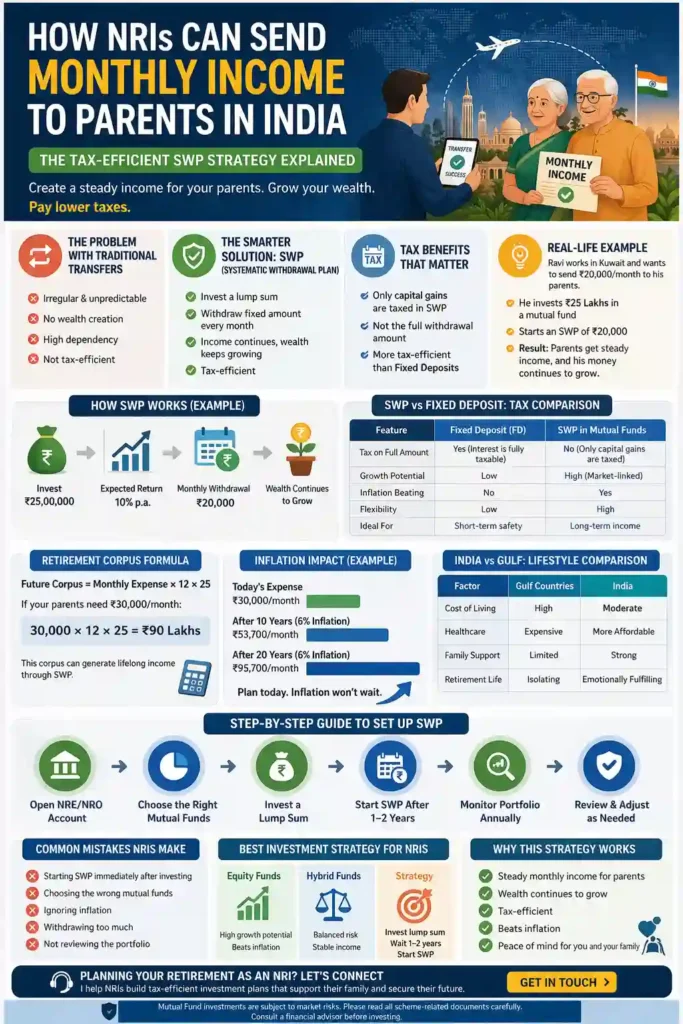
1. What is NRI Monthly Income to Parents Strategy?
The NRI monthly income to parents strategy is about creating a fixed, predictable income for your parents in India using investments instead of manual transfers.
Instead of sending money every month:
- You invest once (lump sum)
- Set up a withdrawal plan
- Parents receive a monthly income automatically
This ensures:
✔ Financial stability
✔ Independence for parents
✔ Peace of mind for you
2. Problems with Traditional Money Transfers
Let’s be honest…
Most NRIs:
- Send money randomly
- Depend on salary cycles
- Don’t plan long-term
Key Issues:
- No consistency
- No wealth creation
- High dependency
- No tax efficiency
Therefore, relying only on transfers isn’t sustainable.
3. What is SWP and How It Works
SWP (Systematic Withdrawal Plan) allows you to:
- Invest a lump sum in mutual funds
- Withdraw a fixed monthly amount
👉 Think of it like a salary for your parents
Example:
| Investment | Return | Monthly Withdrawal |
|---|---|---|
| ₹20 Lakhs | 10% | ₹15,000 |
Even after withdrawal, your investment continues to grow.
4. Tax Benefits Explained
This is where NRI monthly income to parents strategy becomes powerful.
👉 In SWP:
- Only capital gains are taxed
- Not the full withdrawal
Compared to FD:
| Investment | Tax Treatment |
|---|---|
| Fixed Deposit | Full interest taxable |
| SWP | Only gains taxed |
Therefore, SWP is more tax-efficient.
5. Real-Life Example of NRI monthly income to parents
Ravi, working in Kuwait, sends ₹20,000 monthly.
Instead, he:
- Invests ₹25 Lakhs
- Starts SWP of ₹20,000
Result:
✔ Parents get a steady income
✔ Investment grows
✔ Reduced tax
6. Retirement Planning for NRIs
Here’s where we introduce SEO keywords:
👉 NRI retirement planning India
Many NRIs ignore long-term planning.
But think:
“What happens after retirement?”
Retirement Corpus Formula
Future Corpus = Monthly Expense × 12 × 25
If parents need ₹30,000/month:
👉 30,000 × 12 × 25 = ₹90 Lakhs
7. Inflation Impact
Inflation silently destroys wealth.
If expenses today = ₹30,000
After 10 years = ₹50,000+
Therefore, your NRI monthly income to parents must grow.
8. India vs Gulf Lifestyle Comparison
| Factor | Gulf | India |
|---|---|---|
| Cost of Living | High | Moderate |
| Healthcare | Expensive | Lower |
| Family Support | Limited | Strong |
Hence, planning in India is more sustainable.
9. Best Investment Strategy
For NRI monthly income to parents, the best options:
✅ Equity Funds
- Long-term growth
- Beats inflation
✅ Hybrid Funds
- Balanced risk
- Stable income
Strategy:
- Invest a lump sum
- Wait 1–2 years
- Start SWP
10. Step-by-Step Guide for NRI monthly income to parents
- Open NRE/NRO account
- Choose a mutual fund
- Invest a lump sum
- Set SWP
- Monitor annually
11. Common Mistakes NRIs Make
❌ Starting SWP immediately
❌ Choosing the wrong funds
❌ Ignoring inflation
❌ Over-withdrawing
12. Advanced Strategy: Combine Goals
Use NRI retirement planning India + SWP:
- Build a retirement corpus
- Generate monthly income
- Protect family
If you’re an NRI planning retirement, feel free to connect with me. I can help you create a personalised investment plan based on your goals.
FAQs
1. What is the best way for NRIs to send money to their parents?
The best way is using SWP in mutual funds to create a fixed monthly income.
2. Is SWP tax-free in India?
Not fully tax-free, but only capital gains are taxed, making it tax-efficient.
3. Can NRIs invest in mutual funds in India?
Yes, NRIs can invest through NRE/NRO accounts.
4. How much should NRIs invest for monthly income?
It depends on expenses, but typically ₹20–30 lakhs can generate ₹15,000–₹20,000.
5. Is SWP better than fixed deposits?
Yes, SWP offers better returns and tax efficiency.
Disclaimer
Mutual Fund investments are subject to market risks. Please read all scheme-related documents carefully. Consult a financial advisor before investing.