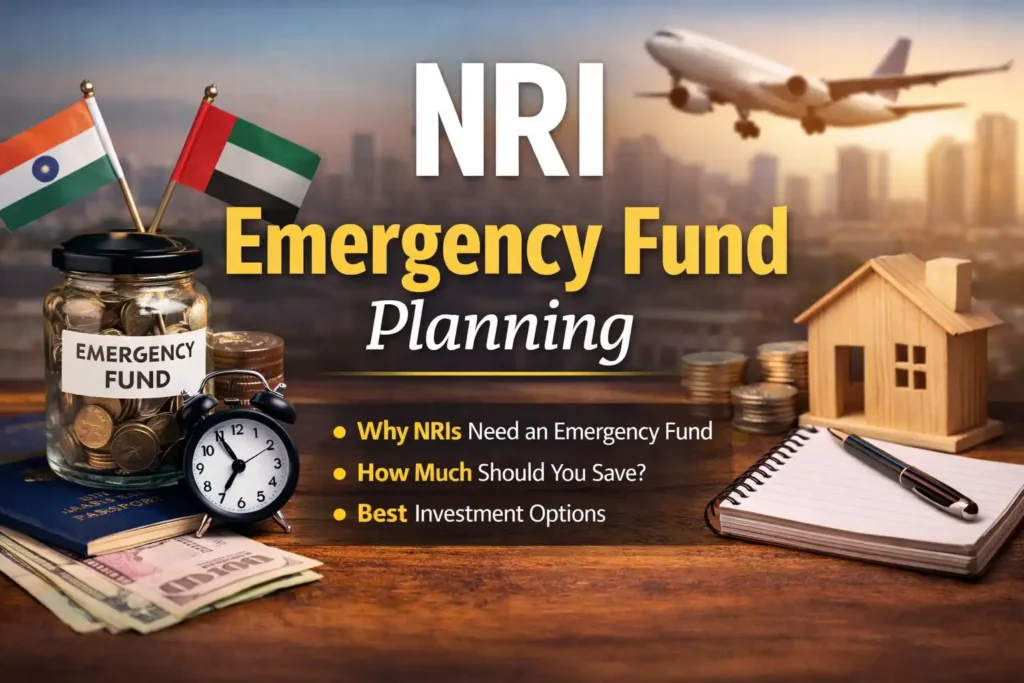
NRI emergency fund planning guide for retirement. Learn how much to save, where to invest, and avoid costly mistakes as an NRI.
NRI Emergency Fund Planning – The Ultimate Guide for Secure Retirement
Introduction
If you’re living in the Gulf and earning well, you might think you’re financially secure.
But here’s the uncomfortable truth…
One job loss, medical emergency, or sudden relocation can shake your entire financial plan.
That’s why NRI emergency fund planning is not optional—it’s essential.
Most NRIs focus on investments, SIPs, or buying property back home. However, they ignore the most important financial foundation:
An emergency fund for NRIs retirement
So, let me ask you:
- What happens if you lose your job tomorrow?
- Can your family survive 6–12 months without income?
- Will you be forced to break your investments?
If you’re unsure, this guide will completely change how you think about money.
- NRI Emergency Fund Planning – The Ultimate Guide for Secure Retirement
- Introduction
- 1. What is NRI Emergency Fund Planning?
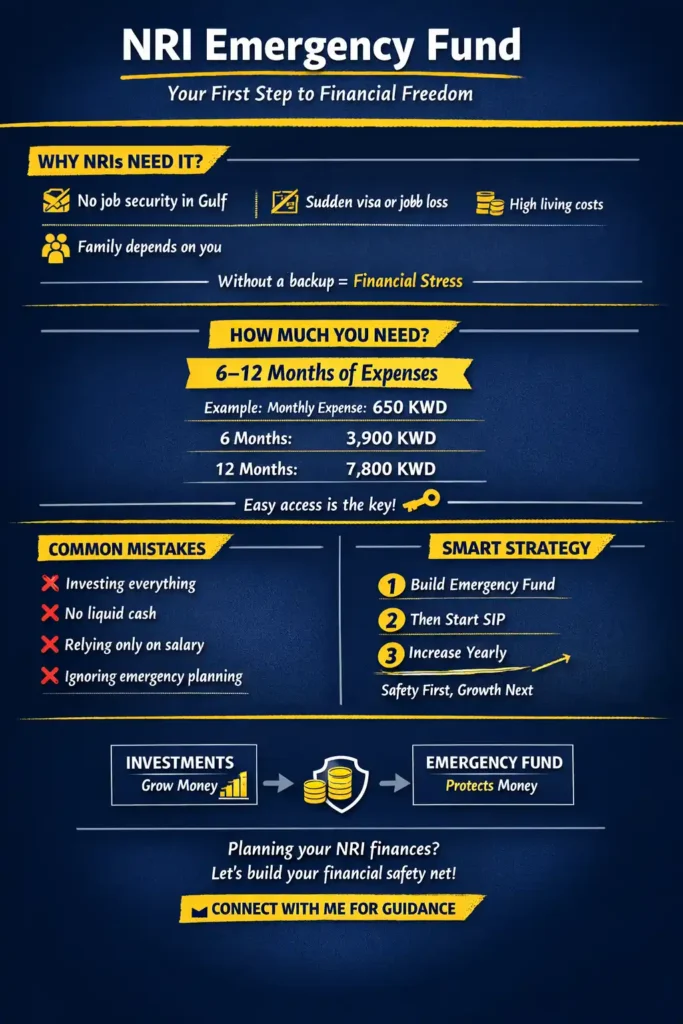
- 2. Why NRIs Need an Emergency Fund Urgently
- 3. How Much Emergency Fund is Enough?
- 4. India vs Gulf Lifestyle Comparison
- 5. Where Should NRIs Keep Emergency Fund?
- 6. Real-Life NRI Case Studies
- 7. Inflation Impact on Emergency Fund
- 8. Common Mistakes NRIs Make
- 9. Best Investment Strategy (Mutual Funds Focus)
- 10. Retirement Corpus Calculation Formula
- 11. Step-by-Step NRI Emergency Fund Planning Guide
- Final Thoughts
- FAQs
- Disclaimer
1. What is NRI Emergency Fund Planning?
NRI emergency fund planning means setting aside money that you can access immediately during unexpected situations.
These situations include:
- Job loss in Gulf countries
- Medical emergencies
- Visa issues or forced relocation
- Family emergencies in India
👉 Simply put, an emergency fund for NRIs retirement acts as your financial safety net.
2. Why NRIs Need an Emergency Fund Urgently
Let’s be real.
Life in the Gulf looks stable—but it’s not guaranteed.
Key Risks NRIs Face:
- No permanent residency in most GCC countries
- Sudden job termination without long notice
- High cost of living
- Dependence on a single income
👉 That’s why NRI emergency fund planning becomes even more critical than for residents in India.
Without it, even a small disruption can destroy years of savings.
3. How Much Emergency Fund is Enough?
This is the most common question.
Ideal Rule:
👉 6 to 12 months of expenses
Example:
| Expense Category | Monthly Cost (KWD) |
|---|---|
| Rent | 250 |
| Food | 120 |
| School Fees | 150 |
| Transport | 50 |
| Miscellaneous | 80 |
| Total | 650 KWD |
👉 Emergency Fund Required:
- 6 months = 3,900 KWD
- 12 months = 7,800 KWD
✔ This is the core of NRI emergency fund planning
4. India vs Gulf Lifestyle Comparison
| Factor | Gulf (Kuwait/UAE) | India |
|---|---|---|
| Job Security | Low | Moderate |
| Cost of Living | High | Moderate |
| Healthcare Cost | High (private) | Variable |
| Family Support | Limited | Strong |
| Emergency Risk | High | Lower |
👉 Therefore, the emergency fund for NRIs retirement must be higher than for Indian residents.
5. Where Should NRIs Keep Emergency Fund?
A common mistake is investing everything.
Don’t do that.
Ideal Allocation:
- 40% – Savings Account (Instant access)
- 30% – Liquid Mutual Funds
- 30% – Short-term Debt Funds
👉 This balanced approach is key in NRI emergency fund planning
6. Real-Life NRI Case Studies
Case 1: Rajesh (Kuwait)
- Lost job during COVID
- Had NO emergency fund
- Broke his long-term investments
👉 Result: Financial stress + losses
Case 2: Anil (Dubai)
- Maintained proper NRI emergency fund planning
- Had 8 months savings
- Found a new job calmly
👉 Result: Zero panic
7. Inflation Impact on Emergency Fund
Most people ignore this.
But inflation silently reduces your money.
Example:
- Today expense = ₹50,000/month
- Inflation = 6%
After 10 years:
👉 Expense = ₹89,542/month
So your emergency fund for NRIs retirement must grow too.
8. Common Mistakes NRIs Make
Avoid these:
- Investing the entire savings in real estate
- No liquidity
- Ignoring NRI emergency fund planning
- Depending only on gratuity
- Mixing emergency fund with investments
9. Best Investment Strategy (Mutual Funds Focus)
Once your emergency fund is ready…
Then invest.
Recommended Approach:
- Step 1: Build emergency fund for NRIs retirement
- Step 2: Start SIPs in mutual funds
- Step 3: Increase SIP yearly
Why Mutual Funds?
- Diversification
- Liquidity
- Better returns than FD
👉 But remember: Emergency fund ≠ investment fund
10. Retirement Corpus Calculation Formula
Let’s simplify.
Formula:
👉 Retirement Corpus = Annual Expenses × 25
Example:
- Monthly expense = ₹50,000
- Annual = ₹6,00,000
👉 Required corpus = ₹6,00,000 × 25 = ₹1.5 Crore
This works alongside NRI emergency fund planning
11. Step-by-Step NRI Emergency Fund Planning Guide
Step 1: Calculate Monthly Expenses
Step 2: Multiply by 6–12
Step 3: Keep funds in liquid assets
Step 4: Don’t touch unless emergency
Step 5: Review yearly
👉 This is the foundation of an emergency fund for NRIs retirement
Final Thoughts
Let’s be honest…
You can earn lakhs every month.
But without NRI emergency fund planning, you are financially fragile.
Think of it like this:
👉 Investments build wealth
👉 Emergency funds protect wealth
And protection always comes first.
If you’re an NRI planning retirement, feel free to connect with me.
I help NRIs:
- Build strong financial foundations
- Create smart investment strategies
- Achieve stress-free retirement
Let’s plan your future—smartly.
FAQs
1. How much emergency fund should an NRI have?
An NRI should maintain 6–12 months of expenses as part of NRI emergency fund planning.
2. Where should NRIs keep emergency funds?
Savings accounts, liquid funds, and short-term debt funds are ideal.
3. Is emergency fund different from investment?
Yes. Emergency fund is for safety, not returns.
4. Can NRIs invest emergency funds in mutual funds?
Partially, in liquid or low-risk funds only.
5. Why is emergency fund important for NRIs?
Because job security abroad is uncertain and relocation risk is high.
Disclaimer
Mutual Fund investments are subject to market risks. Please read all scheme-related documents carefully. Consult a financial advisor before investing.