

Complete guide to personal finance for NRIs. Learn NRI financial planning, investing, tax, retirement, insurance and wealth strategy.
Personal Finance for NRIs: Complete Money System
If you’re an NRI, your money life is different.
You earn in dinars or dirhams.
You invest in rupees.
Eventually, you may retire in India.
That’s why personal finance for NRIs cannot follow a normal Indian template.
There’s currency risk.
There’s tax confusion.
There’s double taxation fear.
There’s emotional property buying.
And unfortunately, there’s mis-selling during every India visit.
So the real question is:
Are you managing money… or just moving money?
In this guide, we’ll build a proper NRI financial planning system. Step by step. No noise. No product pushing. Just clarity.
This page is your complete roadmap for structured personal finance for NRIs.
📌 Table of Contents
- Personal Finance for NRIs – Planning Framework
- Personal Finance for NRIs – Income & Budgeting
- Personal Finance for NRIs – Investment Strategy
- Personal Finance for NRIs – Real Estate Decisions
- Personal Finance for NRIs – Insurance Planning
- Personal Finance for NRIs – Retirement Planning
- Personal Finance for NRIs – Tax Planning
- FAQs on Personal Finance for NRIs
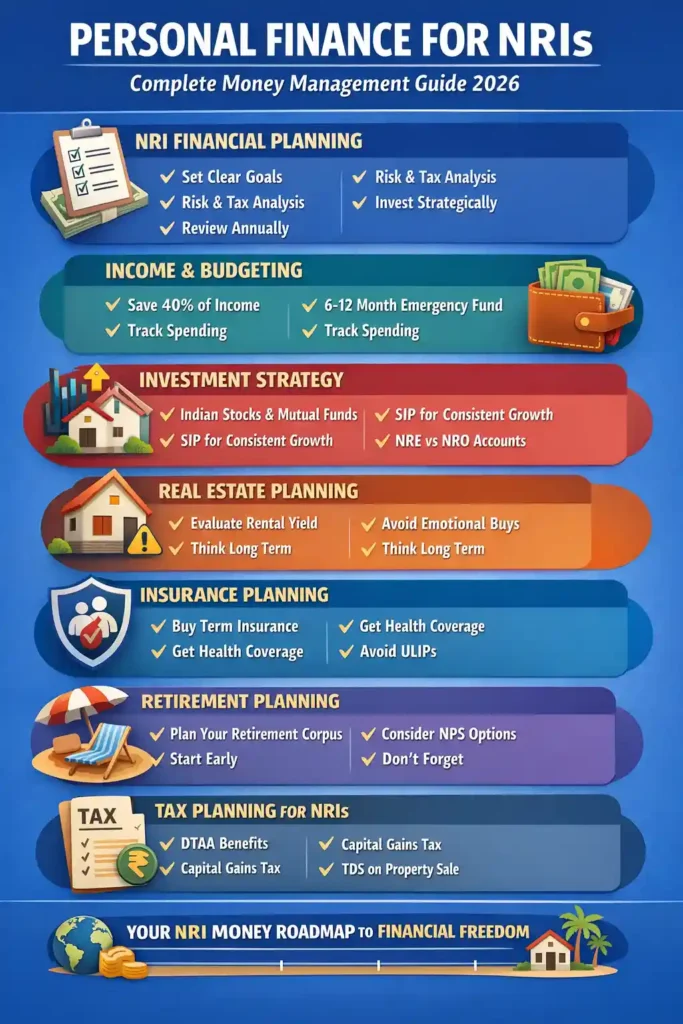
🧭 Personal Finance for NRIs – Financial Planning Framework
Most NRIs invest without a written plan. However, investing without a structure creates stress later.
A proper NRI financial planning framework includes:
- Goal identification
- Cash flow analysis
- Risk profiling
- Tax mapping (India + residence country)
- Asset allocation
- Retirement calculation
- Annual review
Without this, personal finance for NRIs becomes emotional and reactive.
Goal-Based Personal Finance for NRIs
Let’s say you need ₹1.5 crore in 12 years for education.
Instead of randomly investing, you calculate:
- Inflation rate
- Expected return
- Required SIP
Therefore, every investment connects to a goal.
That’s real NRI financial planning.
💰 Personal Finance for NRIs – Income & Budgeting (GCC Focus)
If you live in Kuwait or UAE, you may earn tax-free income. However, tax-free income does not guarantee wealth.
Lifestyle inflation can quietly destroy savings.
40% Savings Rule in Personal Finance for NRIs
A simple rule works well:
- 40% investments
- 40% living expenses
- 10% India support
- 10% lifestyle
For example, if you earn 800 KD, at least 320 KD should go toward investments.
This discipline strengthens NRI financial planning immediately.
Emergency Fund in Personal Finance for NRIs
Many people keep only 3 months of expenses. That’s risky abroad.
Instead, aim for:
- 12 months total reserve
- 6 months in local country
- 6 months in India
Because job loss can mean visa loss.
Therefore, personal finance for NRIs must consider immigration risk.
📈 Personal Finance for NRIs – Investment Strategy
Investing is where most NRIs feel confused. So let’s simplify it.
Can NRIs Invest in Indian Markets?
Yes, through:
- NRE account
- NRO account
- PIS route
However, taxation differs.
That’s why NRI financial planning must include tax alignment before investing.
Mutual Funds in Personal Finance for NRIs
Mutual funds offer:
- Diversification
- Professional management
- SIP discipline
Moreover, they suit busy professionals in GCC.
However, check:
- Repatriation rules
- DTAA benefits
- Tax residency status
Smart NRI financial planning avoids surprises later.
SIP Strategy in Personal Finance for NRIs (Case Example)
Suppose you invest ₹50,000 monthly for 15 years at 12%.
Future value ≈ ₹2.5 crore.
Now imagine delaying by 5 years.
The final corpus drops sharply.
Therefore, early investing is powerful in personal finance for NRIs.
Direct Equity vs Mutual Funds in NRI Financial Planning
Direct equity requires:
- Time
- Research
- Emotional control
Mutual funds require:
- Patience
- Consistency
If you work 10-hour shifts in Kuwait, active trading may not suit you.
Hence, practical NRI financial planning matches lifestyle with strategy.
🏠 Personal Finance for NRIs – Real Estate Planning
Property feels safe. However, numbers often tell a different story.
Should Property Be Core to Personal Finance for NRIs?
Ask yourself:
- What is rental yield?
- What is liquidity risk?
- What is maintenance cost?
In many Indian cities:
- Rental yield: 2–3%
- Equity CAGR (long-term): 10–12%
Therefore, data-driven NRI financial planning often favors equity over multiple properties.
Common Real Estate Mistakes in Personal Finance for NRIs
Many NRIs:
- Buy during vacation
- Overpay due to emotional attachment
- Ignore documentation checks
Unfortunately, these mistakes weaken long-term NRI financial planning.
🛡 Personal Finance for NRIs – Insurance Planning
Insurance is protection. Not investment.
Term Insurance in Personal Finance for NRIs
If you have dependents, buy:
- Pure term insurance
- Adequate cover (15–20× annual income)
Avoid mixing insurance with investment.
Strong NRI financial planning separates risk cover from wealth building.
Health Insurance in Personal Finance for NRIs
If you plan to return to India later, buy Indian health insurance early.
Premiums rise with age.
Therefore, early planning improves personal finance for NRIs stability.
Why ULIPs Often Fail in NRI Financial Planning
ULIPs usually have:
- High charges
- Lock-in period
- Low transparency
Instead, use:
- Term plan
- Mutual funds
This simple structure improves personal finance for NRIs clarity.
🏖 Personal Finance for NRIs – Retirement Planning
Retirement planning is the most ignored part of NRI financial planning.
Retirement Corpus in Personal Finance for NRIs
Suppose your current monthly expense is ₹1 lakh.
After 15 years at 6% inflation:
Expense becomes about ₹2.4 lakh.
Annual expense ≈ ₹30 lakh.
Using 25× rule:
Required corpus ≈ ₹7.5 crore.
Therefore, retirement planning must start early in personal finance for NRIs.
NPS in Personal Finance for NRIs
NPS offers:
- Tax benefits
- Low cost
- Long-term discipline
However, liquidity is limited.
Hence, include NPS only if India retirement is certain.
📊 Personal Finance for NRIs – Tax Planning
Tax mistakes can erase returns.
DTAA in NRI Financial Planning
DTAA prevents double taxation.
However, documentation is essential.
Therefore, personal finance for NRIs must align tax strategy before investing.
Capital Gains in Personal Finance for NRIs
Equity:
- 15% short term
- 10% long term above limit
Property:
- 20% with indexation
Ignoring taxes weakens NRI financial planning.
🚀 Why Personal Finance for NRIs Fails
It fails when:
- There is no written plan
- Investments are product-driven
- Reviews are ignored
- Retirement is postponed
However, when structured properly, personal finance for NRIs creates financial freedom.
✅ Personal Finance for NRIs – The Practical Blueprint
- Save at least 40%
- Maintain 12-month emergency fund
- Buy term + health insurance
- Invest through SIP
- Avoid emotional property purchases
- Calculate retirement corpus
- Review annually
Simple steps. Big impact.
That’s intelligent NRI financial planning.
❓ FAQs on Personal Finance for NRIs
Why is personal finance for NRIs more complex?
Because income, tax laws, and retirement location differ.
What is the biggest mistake in NRI financial planning?
Buying property without evaluating long-term returns.
Should NRIs diversify globally?
Yes. Global exposure reduces risk in personal finance for NRIs.
Is SIP suitable for NRIs?
Yes. It creates discipline and long-term growth.
When should retirement planning begin?
Immediately. Early action strengthens NRI financial planning dramatically.
Final Thoughts
If you’re working abroad, ask yourself:
Are you building wealth… or just earning salary?
Personal finance for NRIs is not about sending money home.
It is about building a structured system.
It is about aligning goals, investments, tax, and retirement.
When done correctly, NRI financial planning transforms temporary foreign income into permanent financial freedom.
And that, ultimately, is the real goal.

Pingback: NRI Financial Planning Framework – A Simple Guide for Your Bright Future - myfinteche.com