Learn how NRI financial planning secures wealth, reduces tax, and builds your future. Expert tips for personal financial planning for NRIs.
Personal Financial Planning for NRIs
📖 Table of Contents
- Introduction: Why NRIs Need Financial Planning
- Understanding Personal Financial Planning for NRIs
- Importance of NRI Financial Planning
- Budgeting & Cash Flow for NRIs
- Building an Emergency Fund
- Investment Strategies for NRIs
- Tax Planning Essentials
- Retirement Planning for NRIs
- Insurance & Risk Management
- Mistakes NRIs Often Make
- Step-by-Step Guide to Start NRI Financial Planning
- Real-Life Example: How NRI Financial Planning Works
- FAQs
- Conclusion
1. Introduction: Why NRIs Need Financial Planning
Living abroad can feel exciting. Yet, managing money in two countries can be confusing. NRIs face currency fluctuations, tax obligations, and investment choices. Without proper planning, these challenges can overwhelm anyone. That’s why personal financial planning for NRIs is essential.
In this guide, we’ll explore NRI financial planning step by step. You’ll learn practical tips, common mistakes, and strategies to secure your wealth. Let’s dive in.
2. Understanding Personal Financial Planning for NRIs
NRI financial planning is about creating a roadmap for your money. It covers budgeting, investing, tax optimization, insurance, and retirement. The goal is to maximize wealth while minimizing risk.
For NRIs, planning is more complex. You must consider:
- Tax laws in both countries
- Currency risk between home and host country
- Investment rules in India and abroad
In short, personal financial planning for NRIs helps you make smart choices across borders.
3. Importance of NRI Financial Planning
Why is this so important? NRIs face unique challenges:
- Managing income in foreign currency
- Saving for retirement in India or abroad
- Planning children’s education across countries
- Protecting family with insurance in two countries
With NRI financial planning, you can handle all these challenges effectively. Moreover, it ensures your money grows while protecting against unexpected risks.
4. Budgeting & Cash Flow for NRIs
Budgeting is the first step in any personal financial planning for NRIs strategy. Without tracking income and expenses, you can’t save efficiently.
Start by asking:
- How much do I earn each month?
- How much am I spending?
- Can I save at least 20% of my income?
Track every source of income, including salary, rental, and dividends. Also, record all expenses. Transition words like then, next, and finally will help organize your plan clearly.
5. Building an Emergency Fund
Unexpected events happen. Job loss, medical emergencies, or relocation costs can hit any NRI. That’s why an emergency fund is crucial.
Rule of thumb: Save 6–12 months of living expenses. Keep it in a liquid account. Don’t use this fund for investing. Instead, treat it as your financial safety net.
6. Investment Strategies for NRIs
Investing is the heart of NRI financial planning. You can invest both abroad and in India. Diversification is key.
Options include:
- Stocks and bonds abroad
- Indian mutual funds and property
- Global index funds
Investing in only one country increases risk. For example, if the host country market crashes, your portfolio suffers. Therefore, personal financial planning for NRIs always recommends diversification.
7. Tax Planning Essentials
Taxes can be tricky for NRIs. They must follow both Indian and foreign tax laws. Proper NRI financial planning reduces the risk of double taxation.
Key points:
- Know your residential status
- Check DTAA (Double Tax Avoidance Agreement) benefits
- Report income abroad correctly
- Use tax-efficient investment accounts
Planning taxes smartly can save thousands annually.
8. Retirement Planning for NRIs
Retirement is a top priority in personal financial planning for NRIs. You must decide where you want to retire — home or abroad.
Consider:
- Retirement income needs
- Inflation adjustments
- Pension and social security rules
- Long-term healthcare costs
Don’t delay. Starting early increases compounding benefits.
9. Insurance & Risk Management
Insurance protects your hard-earned wealth. For NRIs, risk management is crucial.
You need:
- Health insurance abroad
- Life insurance for family back home
- Disability coverage
- Property insurance in India
Insurance ensures your family is safe even if unexpected events occur.
10. Mistakes NRIs Often Make
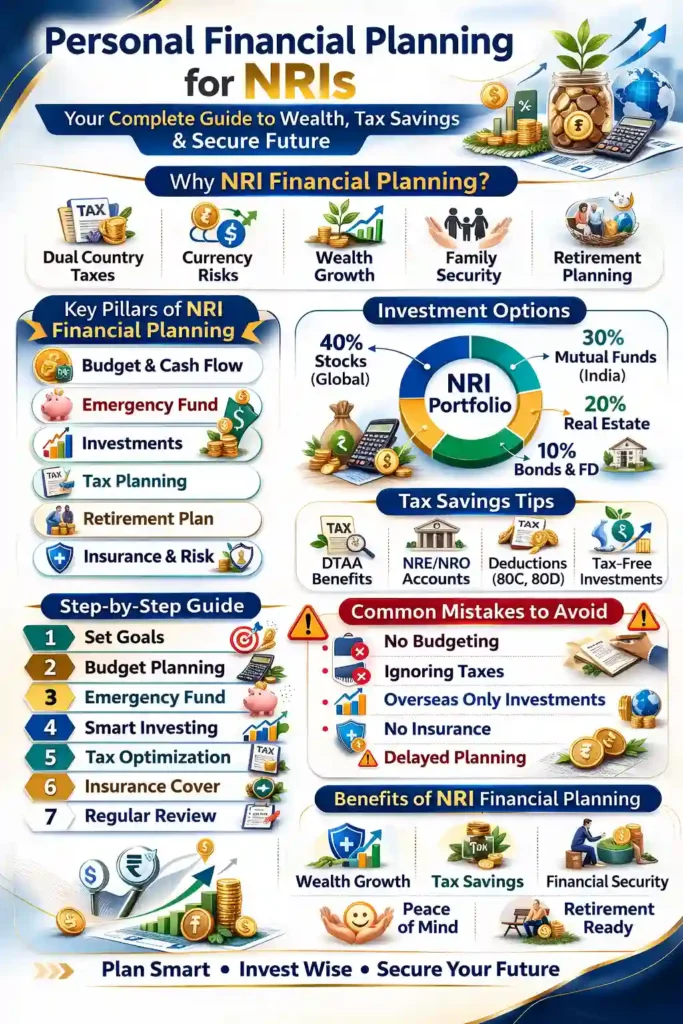
Avoid these common mistakes in NRI financial planning:
- Ignoring budgeting
- Not maintaining an emergency fund
- Random investing without a goal
- Forgetting tax treaties
- Overlooking insurance needs
- Delaying retirement planning
- Holding non-productive assets
- Not reviewing the plan yearly
- Not consulting cross-border experts
Avoiding these mistakes will strengthen your financial journey.
11. Step-by-Step Guide to Start NRI Financial Planning
Start your plan in a few simple steps:
- Define your financial goals
- Track income and expenses
- Build an emergency fund
- List all investments
- Consult tax professionals
- Diversify your portfolio
- Review and adjust annually
Consistency is key. NRI financial planning is a living process that evolves with your life.
12. Real-Life Example: How NRI Financial Planning Works
Meet Rajesh, 35, working in Canada with a family in India. His goals were to:
- Save for kids’ education
- Buy a home in India
- Retire at 60
- Leave a legacy
Here’s his strategy:
| Component | Rajesh’s Plan |
|---|---|
| Budgeting | Saved 25% of income monthly |
| Emergency Fund | 1-year living expenses in liquid CAD |
| Investments | 40% Canadian stocks, 30% Indian mutual funds, 30% global index funds |
| Tax Planning | Leveraged DTAA benefits |
| Retirement | RRSP in Canada, PPF in India |
| Insurance | Health, life, and property coverage |
After ten years, Rajesh has a secure net worth and peace of mind. This is exactly what personal financial planning for NRIs achieves.
13. FAQs
Q1: What is the first step in NRI financial planning?
Start by organizing your income, expenses, and goals. Then build an emergency fund.
Q2: Can NRIs invest in Indian mutual funds?
Yes. NRIs can invest through NRE/NRO accounts. This forms a key part of personal financial planning for NRIs.
Q3: Do NRIs need different financial planning than residents?
Absolutely. They face tax obligations abroad, currency risk, and investment restrictions.
Q4: When should NRIs start planning?
The earlier, the better. Starting now ensures compounding and tax advantages.
14. Conclusion
Personal financial planning for NRIs isn’t optional. It helps manage income, reduce tax, diversify investments, and secure your family’s future.
With smart NRI financial planning, you can navigate currency fluctuations, tax laws, and retirement decisions. Start early, review regularly, and seek expert advice.
Remember, it’s not just about money — it’s about peace of mind. Where do you want your financial journey to take you?